GIFT City sits in Gandhinagar, Gujarat. You can drive to it. Yet the whole point of it is that the law does not treat it as India. That single fact explains everything else about the place, including the parts that sound too good.
It is in India, and the law treats it as outside
Under FEMA, a unit in an International Financial Services Centre — a bank's branch there, a fund registered there — is treated as a person resident outside India. The regulator's own wording is that FEMA applies to transactions between those banking units, treated as resident outside India, and a person resident in India.
So when you deal with an IFSC banking unit you are dealing with something the exchange-control law counts as offshore, without the money leaving the country. IFSCA calls this "onshore the offshore", and it is the design, not a loophole.
Read that precisely. It is the unit that is non-resident — not the postcode, and not you. Your own status is unchanged by any of this.
Everything inside runs in foreign currency
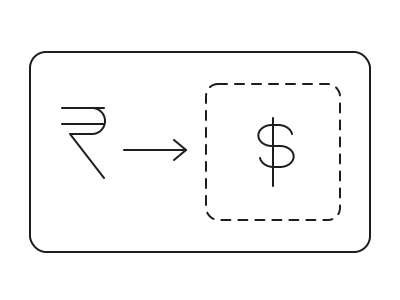
Accounts are held in dollars, euros, pounds. The exchanges settle in foreign currency. This is not presentation — most of the tax treatment below hangs on the consideration being paid in convertible foreign exchange. Rupees do not get you the same answer.
An FCNR(B) deposit does something that looks similar — foreign currency, held in India — but it is an ordinary Indian bank deposit under ordinary Indian rules. The two are not substitutes, and the terms are where you feel it.
An NRE or FCNR(B) term deposit runs for a minimum of one year. Break an FCNR(B) before that year is up and the Reserve Bank's own wording is blunt: "no interest shall be paid." A banking unit at an IFSC works the other way. No minimum term is prescribed at all, and every term deposit it takes from an individual must carry a premature withdrawal facility. The bank sets its own rate and its own penalty.
That freedom has a price, and it is the one worth asking about. Deposit insurance at a banking unit is not automatic. The blanket exclusion was lifted in July 2023, but the regulation still says only that deposits "may be insured" where the DICGC Act applies. Get the answer from your bank in writing before the money moves.
What is actually there
The regulator lists four things an NRI can use:
- A foreign currency account at an IFSC banking unit, with deposits in foreign currency.
- The two IFSC exchanges, India INX and NSE IX — Indian and global equities, ETFs and debt, in foreign currency. They run about 22 hours a day, which is the part that matters if you are in a different time zone.
- Funds registered there — alternative investment funds and mutual funds giving exposure to Indian private equity, real estate and infrastructure.
- Insurance in dollars — term life, health and annuity products from insurers based there.
The tax break is real, and narrower than it sounds
The Income-tax Department's own position: income from the transfer of a capital asset on a recognised stock exchange located in an IFSC is exempt where the consideration is paid or payable in convertible foreign exchange. Securities transaction tax and commodities transaction tax are not levied on those transactions either.
Now read the condition rather than the headline. It is not "investments in GIFT City are tax free". It is transfers on the IFSC exchange, settled in foreign currency. Something you hold another way, or settle another way, is a different question with a different answer.
The ten-year tax holiday is not yours
You will see it quoted: a ten-year tax holiday out of a block of fifteen. That belongs to the entity operating from GIFT IFSC — the fund, the bank, the insurer. It is the reason those businesses are there at all.
It is not a break on your income, and it is the easiest line in any GIFT City brochure to misread as one.
Your own country still taxes you
An Indian exemption is an answer about Indian tax. If you live somewhere that taxes worldwide income — the United States being the obvious case — nothing here changes what you owe there.
The regulator says this too, in its last line, and it is the most useful sentence on the page. A structure that is efficient in India and reportable where you live has not saved you anything.
FATCA and CRS reporting for NRIs
Compare the DTAA rates for two countries
Before you start
Four things to settle, and none of them takes long:
- Which account they can actually open for you. What an individual may hold at an IFSC banking unit has changed over the years and still differs by bank. Ask for the account type in writing.
- Whether the product settles in foreign currency, because the tax treatment above turns on exactly that.
- What your country of residence does with it — before you invest, not at the end of the year.
- That the firm is IFSCA-registered. IFSCA publishes lists of banks, brokers and fund managers, and carries its own warning to deal only with regulated entities. Check the list, not the pitch.
This article is general information, current as at the date shown. It is not legal, tax or investment advice, and nothing here recommends a product or a firm. Sources: the International Financial Services Centres Authority (How NRIs and OCIs Can Leverage GIFT IFSC) for what exists and how to begin; IFSCA's own clarifications for the treatment of a banking unit as a person resident outside India under FEMA, 1999; and the Income-tax Department for the exemption on transfers made on a recognised stock exchange in an IFSC against convertible foreign exchange. The Income-tax Act, 2025 renumbers the 1961 Act throughout, so check the current section before you or your accountant quote one. Deposit terms compared against the RBI Master Direction — Interest Rate on Deposits, 2016 (minimum tenor, and no interest on an FCNR(B) broken inside a year) and the IFSCA Banking Handbook, Conduct of Business Directions v6.0, Module 11, which prescribes no minimum term and requires a premature withdrawal facility on every term deposit from an individual. Deposit insurance is IFSCA Banking Regulations regulation 18, as substituted on 6 July 2023. Checked 24 September 2026.